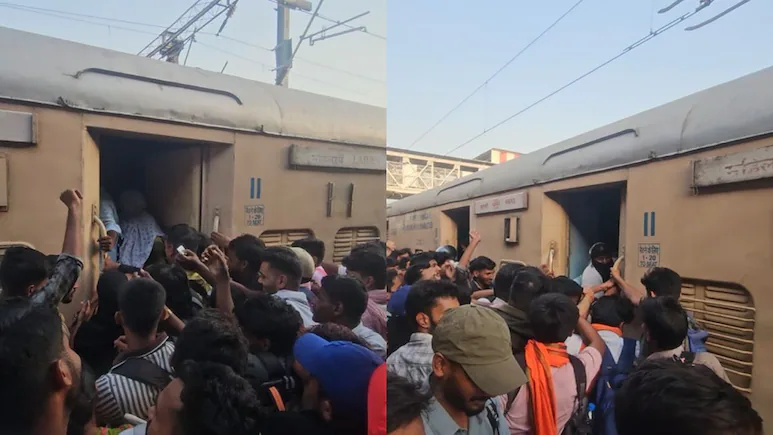
LUCKNOW — Unprecedented scenes of chaos and absolute congestion unfolded at Lucknow’s major transit hubs on Monday evening. Following the conclusion of the high-stakes UP Police Constable Recruitment Exam 2026, an overwhelming deluge of thousands of candidates descended upon Charbagh Railway Station and Lucknow Junction, overwhelming railway infrastructure and severely disrupting normal operations.
The sudden influx triggered significant challenges for railway administration, local law enforcement, and routine commuters traveling across Uttar Pradesh.

🚉 Ground Reality: Platforms Submerged under Waves of Aspirants
Immediately after the final bell of the examination sequence rang, a massive surge of candidates began marching toward the city’s primary rail terminuses. Within an hour, the historic Charbagh Railway Station was virtually gridlocked, with platforms packed to maximum capacity for several hours.
The rush was predominantly driven by outbound aspirants attempting to secure passage back to their hometowns in eastern, western, and central Uttar Pradesh. Trains bound for major regional hubs witnessed intense boarding scrambles, including routes targeting:
-
Gorakhpur
-
Varanasi
-
Kanpur
-
Agra
-
Jaunpur
Desperate Measures Caught on Camera
The sheer volume of travelers resulted in desperate, high-risk boarding maneuvers. Several videos circulating widely on social media platforms showed frantic candidates bypassing coach doors entirely, choosing instead to clamber through open windows to gain entry into moving or stationary trains.
🛑 Operational Collapse Across Premium and General Coaches
While railway authorities anticipated a hike in passenger volume, the actual turnout vastly exceeded the administration’s defensive estimates. The overflow quickly spilled over from general unreserved compartments into reserved areas.

| Coach Category | Impact & Conflict Points |
| General Compartments | Packed far beyond structural safety limits within minutes of train placement. |
| Sleeper Class (Reserved) | Inundated by non-ticketed candidates, rendering reserved berths unusable for legitimate ticket holders. |
| Air-Conditioned (AC) Coaches | Intruding crowds entered premium compartments, causing widespread panic and intense arguments with regular passengers. |
Regular passengers holding confirmed reservations bore the brunt of the mismanagement, facing extreme difficulties simply navigating the platforms or accessing their designated seats.
🚔 RPF and GRP Mobilized to Quell Coach Confrontations
As tempers flared inside crowded compartments over seat usurpation, multiple verbal altercations and minor skirmishes broke out between frustrated regular passengers and exhausted examination candidates.
To prevent a total breakdown of law and order, a massive deployment of the Railway Protection Force (RPF) and the Government Railway Police (GRP) was rushed to the active platforms.
Emergency Measures Enforced by Security Personnel:
-
Forced Evictions: Security personnel systematically intervened inside premium AC and sleeper coaches to clear out unauthorized occupants.
-
Platform Segregation: To alleviate the crippling crush on the active platform edges, security forces redirected incoming groups of candidates into designated holding zones outside the station perimeters.
-
Departure Regulation: Officials worked under extreme duress to clear tracking lines, ensuring that train departures were safely executed despite the human blockades.
🔍 Administrative Shortfalls Despite Emergency Planning
The gridlock occurred despite proactive counter-measures introduced by both state and railway authorities. To facilitate smooth transit, the Northern and North Eastern Railway zones had arranged several route-specific special trains. However, the sheer volume of the candidate pool rendered these extra assets instantly inadequate.
Interestingly, the state government had previously announced a 50% concession in state roadways bus fares specifically for valid examination candidates to distribute the transit load. However, the data from Monday evening conclusively proves that a vast majority of the aspirants actively rejected the highways, collectively preferring the speed and connectivity of rail travel.
The heavy congestion and structural strain at both Charbagh and Lucknow Junction failed to dissipate through the evening, remaining highly substantial until well past midnight.